
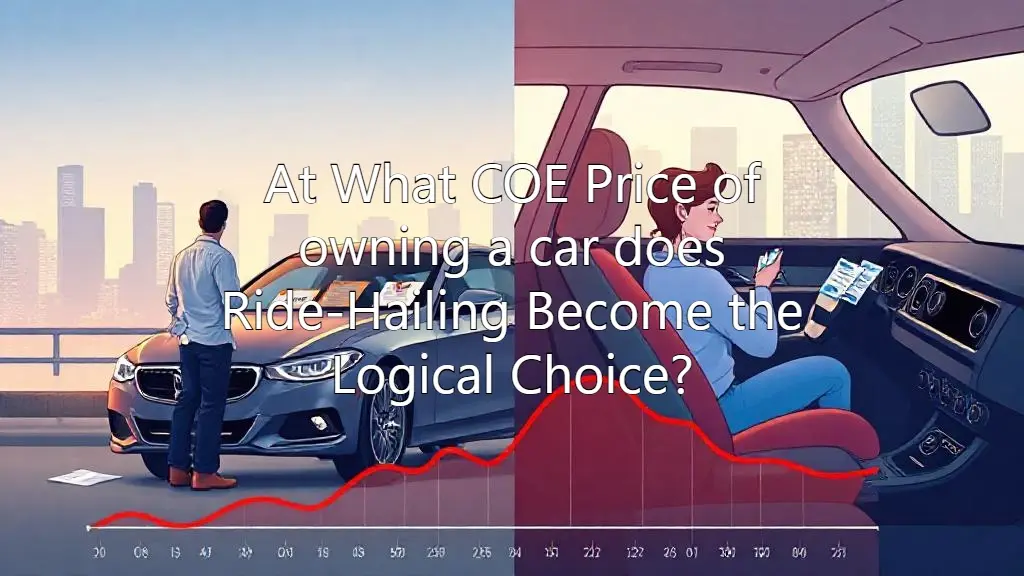

The cost of owning a car in Singapore continues to rise, leaving many to wonder when the convenience of having a personal vehicle becomes a financial burden.
The Certificate of Entitlement (COE) prices play a significant role in determining the overall cost of car ownership, making the question of at what COE price ride-hailing becomes the more logical choice a critical one.
Consider a car as a luxury hotel room. While it provides comfort and flexibility, the daily rates can be steep, and sometimes, a reliable and affordable taxi service can become a more prudent option.
The COE price in Singapore has been fluctuating, influencing the decision of many to opt for ride-hailing services like Grab or Gojek over owning a car.
What is the Break-Even Point for Ride-Hailing vs Car Ownership Annual Costs?
The age-old debate between ride-hailing and car ownership has sparked intense discussion, with many weighing the costs and benefits of each option.
As the world becomes increasingly urbanised, the need for efficient and cost-effective transportation solutions grows.
The break-even point, where the costs of ride-hailing equal those of car ownership, is a crucial consideration for many individuals.
The decision to choose between ride-hailing and car ownership can be a daunting one, with thousands of dollars hanging in the balance.
Key insights include ride-hailing services that can be more cost-effective for those who drive less than 10,000 miles per year.
Car ownership costs like maintenance and insurance can add up quickly, making ride-hailing a more appealing option for some.
The break-even point can vary significantly depending on factors such as location, driving habits and personal preferences.
Calculating the True Cost of Owning a Car in Urban Areas with High Parking Fees
As you navigate the crowded streets of Singapore, you might find yourself wondering if owning a car is still a viable option, considering the exorbitant parking fees and costs associated with vehicle maintenance.
Parking fees can quickly add up, and other expenses that come with car ownership, such as fuel, insurance, and repairs, should also be factored in.
The true cost of owning a car lies in the hidden expenses, like parking costs, that can make or break the decision to own a car or use ride-hailing services.
Ride-Hailing Services as a Primary Mode of Transportation for Low-Mileage Drivers
Ride-hailing services offer a flexible and affordable alternative to traditional car ownership, especially for low-mileage drivers who may not need to use their vehicles frequently.
With the rise of ride-hailing platforms, individuals can easily book a ride and pay only for the trips they take, eliminating the need for expensive car loans, insurance, and maintenance costs.
In addition to the financial benefits, ride-hailing services also provide an opportunity for social interaction and community building, as drivers and passengers can engage in conversations and share experiences during their journeys.
How Do Parking Costs Affect the Decision to Own a Car or Use Ride-Hailing Services
The decision to own a car or use ride-hailing services is a complex one, with numerous factors influencing this choice, and parking costs are a significant consideration.
Parking costs can be a substantial burden, especially in urban areas where parking fees can be exorbitant, and the hunt for a parking spot can be frustrating and time-consuming.
Ride-hailing services, such as Uber and Grab, offer a convenient and often more affordable alternative, with the added benefit of not having to worry about parking.
Comparing the Annual Costs of Ride-Hailing vs Car Ownership for Medium-Size Sedans
When considering the costs of transportation, many individuals weigh the pros and cons of ride-hailing versus car ownership, particularly for medium-sized sedans.
The annual costs of owning a car can be substantial, including expenses such as fuel, maintenance, insurance, and parking.
In contrast, ride-hailing services offer a more flexible and potentially cost-effective alternative, with users only paying for the trips they take.
According to the Motorist Smartbuy guide and AsiaOne News, Ownership vs ride-hailing costs:
| Cost Component (Monthly) | Car Ownership | Ride Hailing |
| COE (Cat A, B, E) | $1,039.92 to $1,064.17 | — |
| Fuel / Distance Fare | $342 (Based on 2 tanks/month) | $900 ($20/trip average) |
| Depreciation / Platform Fees | $1,375 (10-year cycle) | $300 ($5/day in fixed rates) |
| Parking / ERP | $260 (HDB Season + Office) | $0 |
| Insurance and Road Tax | $175 (Annualised) | $0 |
| Maintenance and Servicing | $75 (Annualised) | $0 |
| Surge Fees | $0 | $180 (Rain / Peak Surges) |
| Total Per Month | Approx. $2,227 | Approx. $1,380 |
Factors Affecting the Cost-Effectiveness of Ride-Hailing in Urban Areas with Free Parking
The cost of ride-hailing services can fluctuate greatly depending on several factors, including:
- Influencing demand and supply in the market, surge pricing plays a significant role.
- Determining the overall cost, fuel prices and vehicle maintenance are essential considerations.
- Regulating the industry, government policies and regulations can impact the cost-effectiveness of ride-hailing services.
- Enhancing the user experience, the quality of service and availability of drivers can also affect costs.
- Supporting the growth of ride-hailing, investment in technology and infrastructure is crucial.
Ride-Hailing Costs per Mile vs Car Ownership Costs per Mile for Urban Drivers
As urban drivers weigh their options, considering the rising costs of fuel, maintenance, and parking, the decision between ride-hailing and car ownership becomes increasingly complex.
The average cost of a ride-hailing can range from $1.50 to $3.00 per mile, depending on the service and location.
For car owners, the costs are more nuanced, including depreciation, insurance, fuel, maintenance, and parking.
Determining the Optimal COE Price for Car Ownership vs Ride-Hailing in Cities
Contrary to popular belief, owning a car in a city like Singapore can be more cost-effective than relying on ride-hailing services.
The common myth that car ownership is a financial burden is being challenged by the rising costs of ride-hailing.
In reality, the costs of owning a car can be mitigated by factors such as the Certificate of Entitlement (COE) price.
When Does Ride-Hailing Become a Viable Alternative to Car Ownership for Urban Commuters
As urban commuters continue to navigate the complexities of transportation, ride-hailing services have emerged as a potential alternative to traditional car ownership.
The viability of ride-hailing as a substitute for car ownership depends on various factors, including the frequency and duration of trips, the availability of reliable public transportation, and the overall cost of owning and maintaining a vehicle.
Ultimately, the shift towards ride-hailing as a viable alternative to car ownership reflects a broader cultural shift towards mobility-as-a-service, where commuters prioritise access over ownership.
The COE price becomes a critical tipping point, beyond which the freedom of having a car begins to lose its appeal.
With the COE price hovering around $90,000 in Singapore, many are being forced to reconsider their transportation options, and for those who value flexibility and affordability, ride-hailing is becoming an increasingly attractive alternative.
As the city-state continues to evolve and innovate, it’s likely that the lines between personal vehicle ownership and shared mobility will become even more blurred.
Related to Ride-hailing:
Car Rentals in New Zealand: 11 Driving Tips & Tricks
Car Costs: Low SES & High SES Alternatives (Public Transport/Grab)