

The coworking space revolution has been gaining momentum over the past decade, and it’s no surprise why.
As the modern workforce continues to shift towards remote and hybrid work models, the traditional office setting is no longer the only game in town.
The Advantages of a Coworking Space

Source: Pexels
One of the biggest advantages of coworking spaces is their cost savings.
With the rise of hybrid work, many businesses simply can’t justify the costs of running a traditional office.
According to Gallup data in 2022, only two out of 10 workers work fully on-site.
Many companies are desiring alternatives to the traditional office that make sense with their new operations.
With Cowork, office setups can be optimised to fit the team’s needs and boost productivity.
Because coworking spaces don’t require as much overhead for businesses, cost becomes a key selling point in attracting businesses to them.
Another major benefit of coworking spaces is their ability to foster innovation and collaboration. These spaces have a track record of incubating successful companies. 🤝
Some successful companies that share a foundation in coworking are Airbnb, Uber, and Spotify.
Promoting these success stories can attract entrepreneurs and businesses seeking opportunities to collaborate and catch that innovative spark.
Niche Coworking Spaces
An emerging trend in coworking is flex spaces tailored to specific industries.
Examples of these industries include tech, art, and sustainability.
Industry-specific spaces are a unique opportunity for flex space owners.
They can position your workspace as a vital hub with like-minded professionals — another competitive advantage to offering a coworking model.
With the growing corporate focus on environmental responsibility, you can market to companies looking to reduce their carbon footprint. 👣
The Disadvantages of a Coworking Space

Source: Pexels
While coworking spaces offer many benefits, they’re not without challenges.
One major concern is privacy and security.
Coworking space managers have to work harder at guaranteeing data privacy and security for clients.
Because networks are shared and conversations can be overheard, safeguarding private information is essential.
Many operators are installing private phone booths for sensitive calls and more secure Wi-Fi networks.
Another challenge is distractions and noise. 🔊
The same environment that brings connection and networking can also bring noise and distraction.
Businesses need both collaborative and quiet spaces for their employees. 🤫
Building owners are increasingly incorporating these quiet zones so that employees can work with a deeper focus.
What Is Considered a Traditional Office?

Source: Pexels
A traditional office is a dedicated physical space for a company.
Large corporations, healthcare facilities, and government agencies commonly use it.
Traditional offices typically contain private offices, meeting rooms, and communal areas, all housed under one roof. 🏠
The business pays for a lease to rent the location or, less commonly, owns the building outright.
The Advantages of a Traditional Office
Source: Pexels
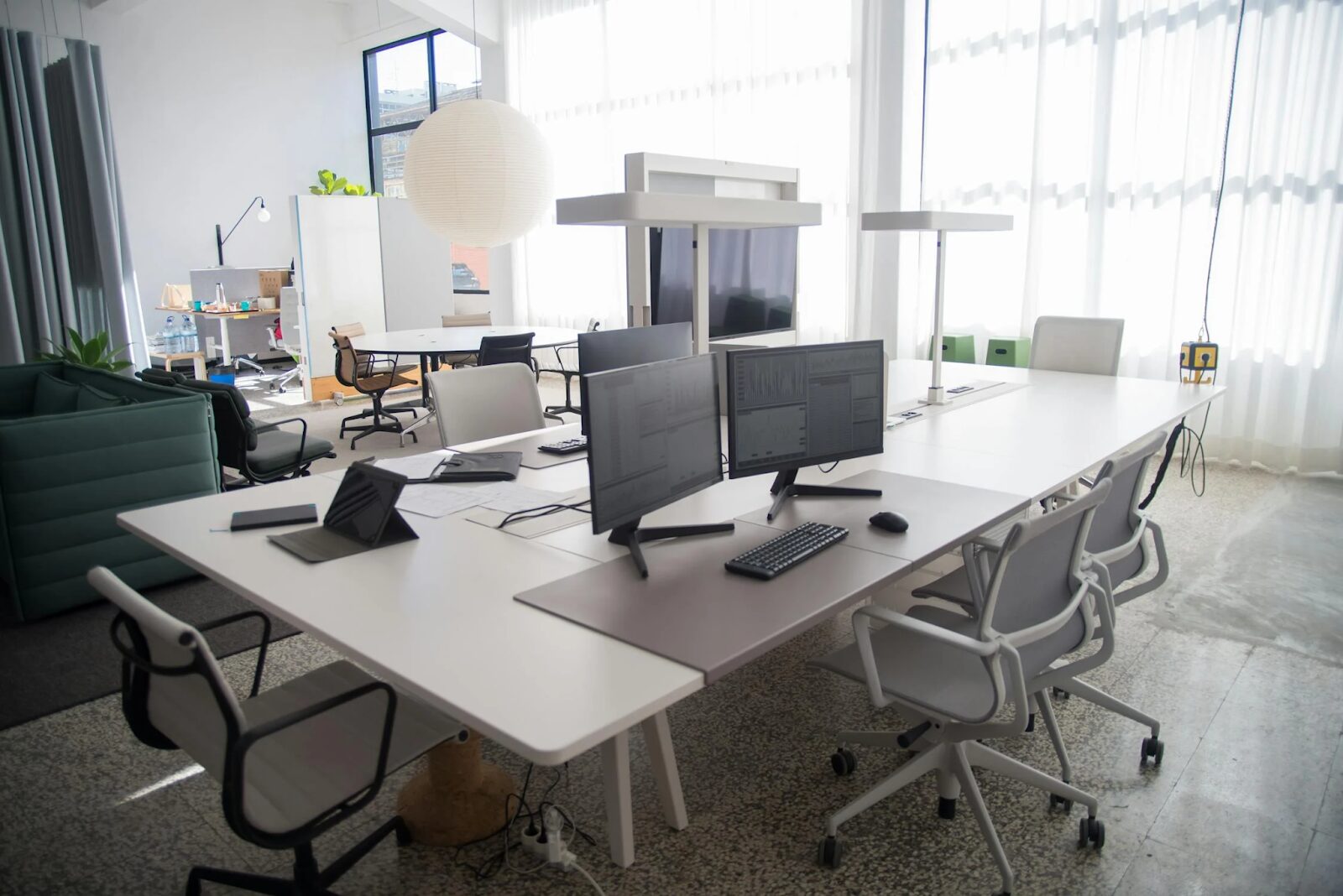
One of the biggest advantages of a traditional office is its professional image.
A traditional office’s physical presence can be a powerful element of a company’s image.
The company can showcase its brand through a modern design in a prime location. 📍
These offices provides your clients with a sense of legitimacy that can impress their customers and partners.
Another major benefit of traditional offices is their focusability.
A client in a traditional office has more control over their workspace.
Innovative designs and thoughtful layouts can improve their productivity.
They can also minimise distractions and create environments ideal for deep focus.
The Disadvantages Of A Traditional Office

Source: Pexels
Despite the structure and control traditional offices provide, they come with some significant challenges for businesses in today’s world.
One major concern is high costs. 💰
The cost of maintaining a traditional office space can be substantial.
Companies that choose the traditional route face expenses such as rent, utilities, and equipment.
Another major drawback is limited flexibility.
Companies in a traditional office setting can feel constrained.
Expensive, lengthy leases make it challenging to scale up for growth or downsize and streamline operations.
Some workforces also swell or shrink based on the season or project needs.
How Do You Know Which Work Space Is Right for Your Business?
This is one of the most common questions that your potential members are asking themselves.
Deciding between a coworking space and a traditional office is a pivotal choice.
It hinges on many factors that are unique to your business. 🧑💼
To make this decision, businesses usually consider the size of their teams and the growth stage of their company.
Tips for Capitalizing on the Growing Demand for Coworking Spaces
Here are some tips for better-serving businesses choosing to work from a coworking space.
Understand the needs of your clients and adapt to their changing requirements.
Offer flexible membership plans and scalable solutions.
Integrate the latest technology and amenities to stay ahead of the competition. 🧑💻
Final Recommendation
There’s, of course, no one “right” answer for all organizations.
However, the future of work is leaning toward remote, adaptable, and project-based models.
Coworking spaces are inherently designed to accommodate these trends.
(Interested in exploring coworking space options for your business? CoWorkSpace offers various solutions for small and large teams alike.)
In conclusion, coworking spaces and traditional offices each have their own unique advantages and disadvantages.
By understanding the needs of your business and weighing the pros and cons, you can make the right decision for your company.
Related to Coworking Office:
How to Select a Suitable Office Space to Maximise Productivity