

May I have some Chai Tea, please?
This is a common order that you hear, especially when referring to Indian tea.
Yet, bizarrely, saying “chai tea” is like saying “tea tea”. So are the terms “Chai” and “Tea” the same thing?
Technically, yes. Both terms would refer to the same beverage, and their difference stems from their historical roots in trade routes.
Thus in different parts of the world, some say “Tea” while others say “Chai”. 🍵
Tea Originated From Fujian And Spread Via Sea Trade Routes
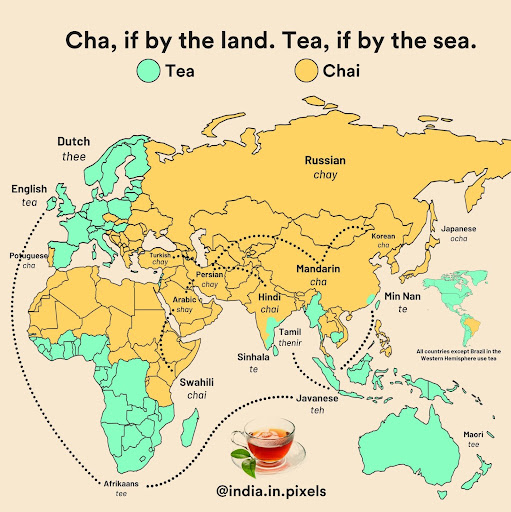
At the heart of this story lies a simple linguistic distinction: “Tea if by sea and Chai if by land.”
This phrase sums up how ancient trade routes affect the spread of languages across continents.
The word ‘Tea’ comes from the coastal Min Chinese dialect spoken in the Fujian province.
In the Min Chinese dialect, it was pronounced as ‘teh’ (sounds like tay).
European traders, particularly the Portuguese, Dutch, and later the British, adopted this term as they accessed China via sea.
Chai Originated From Mandarin Chinese And Spread Via The Silk Route
On the other hand, Chai comes from the Mandarin word chá (茶).
As the commodity passed through the Silk Road into Central Asia, Persia, and beyond, so did the uses of the word. 🌏
In Persia, the word became chay (چای), which became Chai in India (they sound relatively similar).
Isn’t it mind-blowing how language and culture are shaped by ancient trade interactions between nations? 🤯
India’s Uses A Blend Of Strong Spices To Make Chai
If you have had tea from these different parts of the world, Chai stands out with a distinct spiced flavour.
The use of spices has its roots in Ayurvedic medicine, an ancient Indian system of healing, that uses spices for their medicinal properties.
Be it ginger, cinnamon, lemongrass, holy basil and peppercorns… Literally, any spice can be added to Chai.
Every family has a spice blend to suit its tastes, so every cup is unique.
So, don’t be afraid to make the blend that best suits your tastes. It is still Chai. 😃
(🤔Did you know? Masala Chai, a popular chai beverage is often prepared with ginger, cinnamon, clove, cardamom, and black pepper)
The Evolution Of Chai Through Colonialism
When the British colonised India, Chai transformed from just being spiced tea.
The British East India Company began large tea cultivation in India, to capitalise on the growing tea trade.
They promoted tea drinking in the local Indian population to boost demand.
In Britain, they practice adding milk and sugar to tea, completely different from the way Chai was drank in India.
The chaiwalas (tea vendors) started to mix Chai with milk and sugar and sold the beverage across the country.
Today, one is more accustomed to the milk-sweetened Chai as a result of this historical development.
From India to North America, How Chai Turned Into Chai Latte
As the world grew more connected, the beauty and joy of Chai was discovered by the world and its influence found its way to Europe, North America, and other parts of the globe.
It is quite apt considering the journey that Chai has taken, and how it has evolved as it moves across different cultures. 🌎
In Western countries, people have modified Chai to the Chai Latte that we commonly see in cafes.
Chai Latte is spiced black tea together with steamed milk.
Today, it has become a staple beverage in most cafés. 🧋
This modern version of Chai is a testament to the ever-evolving form of Chai that is moulded from the culture that it is brought to.
There Is No Such Thing As “Chai Tea”🫖
When you say “chai tea”, you’re saying “tea tea”.
The confusion around this terminology started when chai was first introduced to a new audience outside of India.
Using the word Chai may have been too unfamiliar, giving rise to the term “chai tea,” giving people a translation that they could easily understand.
In most cases, the correct term is Masala Chai.
So when you make your next spiced tea purchase, just remember to not use “Chai Tea”, in order to honour the rich cultural history behind this beloved beverage.
Related to Chai Tea:
Huawei Users: Get 6 Partea Bubble Teas For Free In July Just By Flashing Your Phone
Farmstay in New Zealand? – Try Mount Nicholas Farm Experience Instead!